For a business, electricity is not just another monthly bill. It is a recurring operating expense that can influence pro
duction costs, profitability, and long-term growth. From factories and warehouses to offices, hotels, hospitals, schools, retail stores, and commercial buildings, businesses are increasingly exploring solar energy as a smarter way to manage their power requirements.
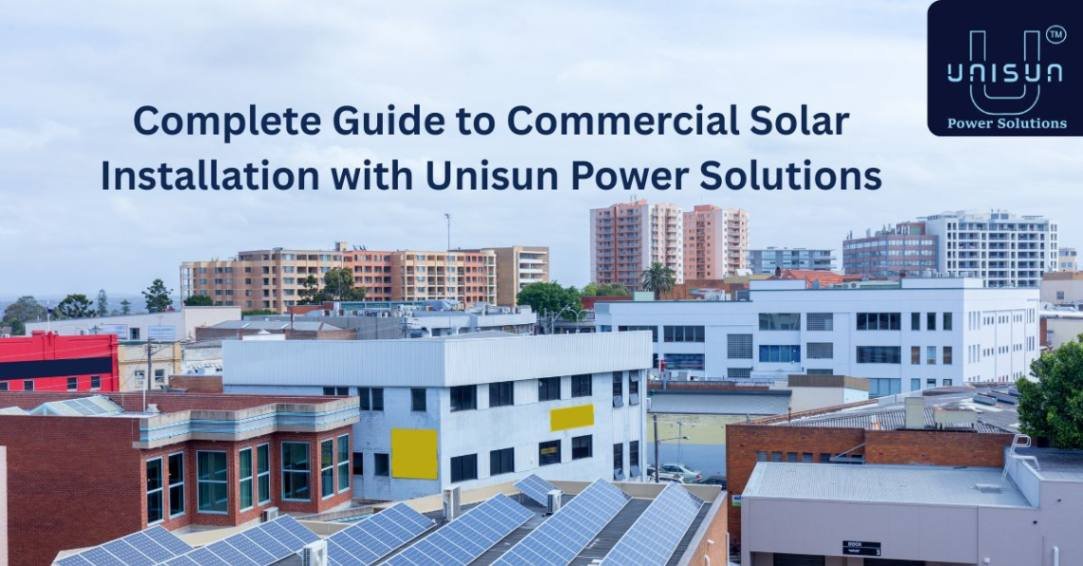
A well-planned commercial solar installation can help businesses generate electricity from their own rooftop, reduce dependence on conventional grid power, and make better use of available space. But commercial solar is not simply about putting solar panels on a roof. The real difference comes from choosing the right system design, equipment, installation approach, documentation support, and EPC partner.
That is where Unisun Power Solutions stands apart. We focus on providing end-to-end commercial solar solutions designed around the actual requirements of your business.
What Is Commercial Solar Installation?
A commercial solar installation is a solar photovoltaic system designed to generate electricity for a business or commercial property. Solar modules convert sunlight into DC electricity, while an inverter converts it into AC electricity that can be used by the property’s electrical loads.
The system capacity is not determined by rooftop size alone. A professional design considers electricity consumption, daytime load, sanctioned load, available roof area, shading, electrical infrastructure, location, and future requirements.
This makes every commercial solar project different. A factory with heavy machinery will have different requirements from an office building, warehouse, hotel, or retail outlet.
Why Are Businesses Switching to Commercial Solar?
Electricity costs are a major concern for businesses, particularly those with high daytime energy consumption. Solar allows businesses to generate part of their electricity requirements on-site rather than relying entirely on grid power.
Some key advantages of commercial rooftop solar include:
- Potential reduction in electricity expenses
- Better long-term energy cost planning
- Productive use of unused rooftop space
- Reduced dependence on conventional electricity
- Lower carbon emissions
- Support for corporate sustainability goals
- Greater control over energy generation
For businesses operating mainly during daylight hours, a rooftop solar system can be particularly useful because solar generation naturally occurs when many commercial facilities are active.
Step 1: Start With Your Electricity Consumption
Before discussing panels, start with your electricity bill.
First understand how much electricity your business consumes and when that electricity is being used.
Reviewing multiple months of electricity bills can reveal average consumption, seasonal variations, demand patterns, and the potential solar capacity required
Step 2: Professional Site Assessment
The next stage is a detailed site survey.
This step is critical because two buildings with the same electricity consumption may require completely different solar designs.
A proper site assessment create a commercial solar power system that is practical, safe, and designed for the property’s actual conditions.
Step 3: Designing the Right Commercial Solar System
Once the site and energy requirements are understood, the system is engineered accordingly.
A typical commercial solar installation can include:
- Solar PV modules
- Grid-connected solar inverters
- Mounting structures
- DC and AC cables
- Protection equipment
- Earthing systems
- Lightning protection where required
- Monitoring systems
- Other balance-of-system components
The goal is to develop an efficient system that balances energy generation, rooftop availability, safety, electrical compatibility, maintenance, and business requirements.
Step 4: Selecting Quality Solar Components
The quality of a solar installation depends on more than the panels.
Modules, inverters, mounting structures, cables, connectors, protection equipment, and other components all contribute to the overall performance and reliability of the system.
When evaluating commercial solar installation companies, businesses should therefore look beyond the initial quotation.
A lower upfront price does not necessarily mean better value.
Businesses should consider:
- Product specifications
- Manufacturer warranties
- Inverter efficiency
- Module performance
- Mounting structure quality
- Protection and safety systems
- Monitoring capabilities
- Installation workmanship
- Service and support
Unisun Power Solutions focuses on building solutions around the project’s technical requirements instead of treating every commercial property as the same.
Step 5: Professional Installation
After engineering and equipment selection, installation begins.
Solar modules are installed using suitable mounting structures, followed by electrical connections between the panels, inverter, protection systems, and building’s electrical infrastructure.
Commercial projects require careful attention to cable management, earthing, electrical safety, structural stability, equipment placement, and maintenance access.
Unisun Power Solutions manages the project with a focus on proper execution.
Step 6: Testing and Commissioning
Before the solar plant is put into regular operation, the installation needs to be inspected and tested.
The relevant electrical connections, inverter configuration, protection systems, earthing, and system operation are checked.
Once the system is commissioned, monitoring can help track solar generation and identify unusual performance changes.
This matters because commercial solar should be viewed as a long-term energy asset. Proper installation and regular monitoring can help businesses get more value from their investment over time.
Unisun Power Solutions can assist businesses through the relevant project process so that technical and documentation requirements are addressed as part of the overall solution.
What Determines Commercial Solar Installation Cost?
There is no universal price for a commercial solar installation.
The total project cost can vary based on:
- System capacity
- Solar module selection
- Inverter capacity and type
- Rooftop structure
- Electrical infrastructure
- Cable requirements
- Installation complexity
- Project location
- Safety equipment
- Documentation and approval requirements
Instead of relying on a generic online price, businesses should get a customised assessment and quotation based on their property and energy requirements.
Why Unisun Power Solutions?
Choosing a solar company is ultimately about more than buying solar panels.
It is about finding a partner that understands the complete journey from planning to performance.
What makes us different is our focus on the complete commercial solar project rather than a panel-only sale.
Business-first planning
We start by understanding your electricity consumption, operating requirements, and property before recommending a system.
End-to-end EPC support
From site assessment and system design to installation and commissioning, we help manage the key stages of your solar project.
Solutions built around your property
Every rooftop is different. We account for rooftop conditions, shading, electrical infrastructure, available space, and business requirements when developing the system.
Focus on long-term value
A commercial solar system is a long-term investment. We focus on appropriate system design, quality components, professional execution, and ongoing support.
Support beyond installation
Our relationship with a business does not end when the panels are installed. Monitoring, documentation, guidance, and post-installation support are important parts of the overall solar experience.
Who Can Benefit From Commercial Solar?
Commercial solar panels can be considered by a wide range of businesses and organisations, including:
- Manufacturing facilities
- Factories
- Warehouses
- Offices
- Hotels and resorts
- Hospitals
- Schools and colleges
- Shopping complexes
- Retail stores
- Restaurants
- Commercial buildings
- Institutions
If your business has consistent electricity consumption and suitable rooftop or ground space, a solar assessment can help determine whether a commercial solar project is appropriate.
Is Commercial Solar a Smart Investment?
For many businesses, solar can be an important part of long-term energy planning. However, the actual financial and energy benefits depend on factors such as electricity tariffs, consumption patterns, solar resource, system size, installation cost, available space, and applicable regulations.
That is why Unisun Power Solutions does not believe in one-size-fits-all recommendations.
Build Your Commercial Solar Future With Unisun Power Solutions
A successful commercial rooftop solar installation requires more than solar panels on a roof. It requires engineering, planning, quality equipment, skilled execution, documentation, commissioning, and reliable support.
That is the difference between simply installing solar and building a solar solution for your business.
With Unisun Power Solutions, businesses can explore a complete commercial solar solution designed around their energy requirements and property.
Whether you are looking to reduce electricity expenses, make better use of your rooftop, strengthen your sustainability efforts, or take greater control of your energy future, our team can help you take the next step.
Ready to explore solar for your business? Contact Unisun Power Solutions for a customised commercial solar assessment and take the first step toward smarter energy management.